

Defining the Multicultural Church and Its Biblical Mandate
Personal transformation often thrives within communities that embrace and celebrate diversity. As our societies become increasingly interconnected, the concept of a multicultural church has never been more relevant. Many of us seek spiritual homes where different backgrounds converge, fostering growth and deeper understanding.
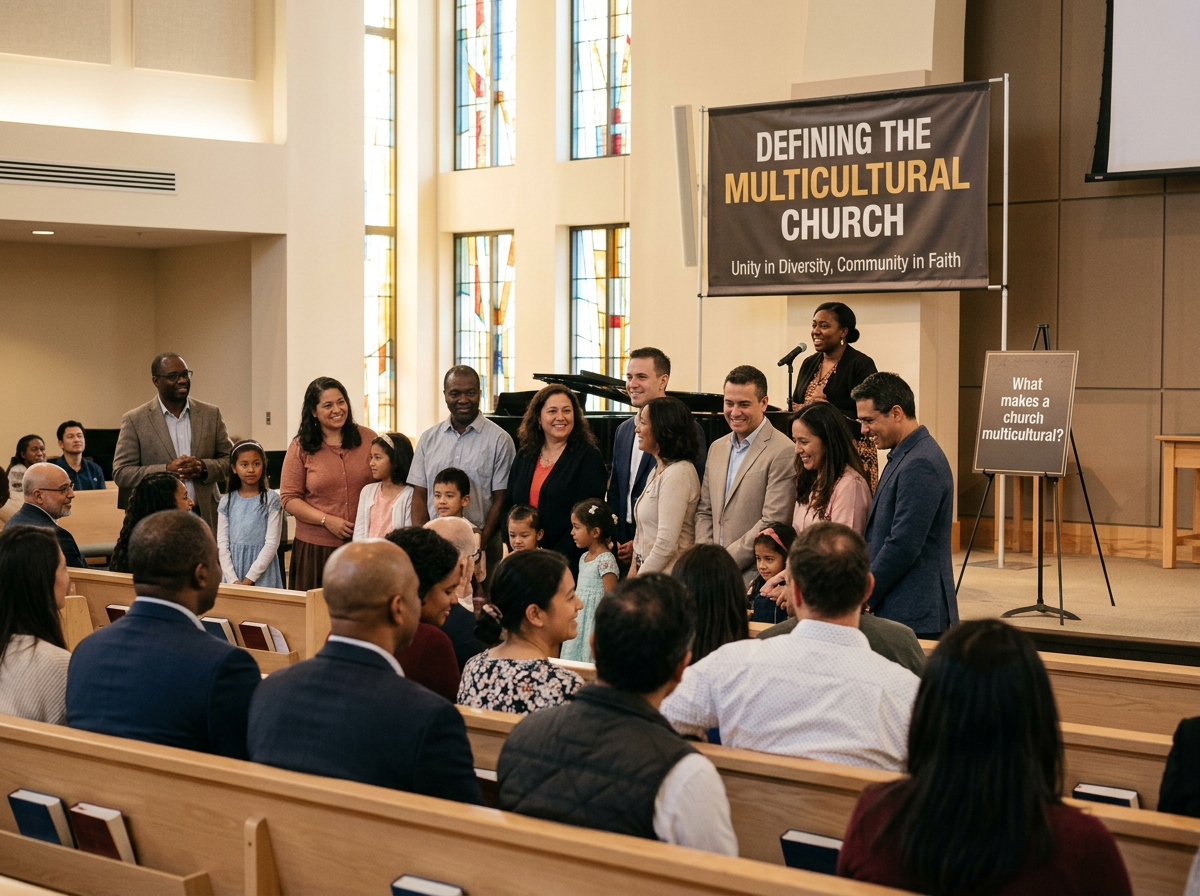
A multicultural church is more than just a diverse gathering. It is an intentional community where people from various ethnic, racial, and cultural origins come together, reflecting the rich tapestry of God’s creation. This environment celebrates differences while actively pursuing unity in faith.
Understanding what truly defines a multicultural church is key to appreciating its unique contribution to personal and communal flourishing. It’s within such a vibrant Multicultural spiritual community that individuals often find profound opportunities for growth and connection.
In this extensive guide, we will clarify the precise definition of a multicultural church and distinguish it from related terms. We will explore its deep biblical foundations, examine its numerous advantages and inherent challenges, and discuss how it promotes personal transformation through genuine community engagement. Finally, we will consider its vital role in our rapidly changing global landscape.
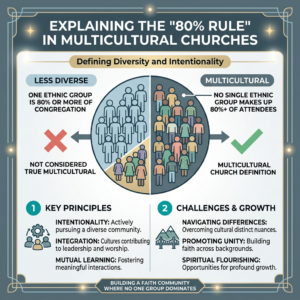
At its core, a multicultural church is a congregation intentionally composed of individuals from two or more distinct ethnic groups, where no single group constitutes an overwhelming majority. The most commonly cited metric for this is the “80% rule,” which defines a multicultural or multiethnic church as one in which no single ethnicity comprises 80 percent or more of the congregation. This numerical benchmark, however, is just one aspect of a deeper commitment to diversity and inclusion.
While often used interchangeably, terms like multicultural, multiethnic, multiracial, and mosaic church carry distinct nuances. Understanding these differences is crucial for churches striving to embody God’s diverse kingdom.
To clarify these distinctions, consider the following table:
The biblical mandate for such diversity is undeniable. From the Old Testament promise to Abraham that “all peoples on earth will be blessed through you” (Genesis 12:3) to the Great Commission to “make disciples of all nations” (Matthew 28:19), God’s plan has always been global and inclusive. Missiologists like Ralph Winter and Paul Hiebert have emphasized the importance of reaching every “ethne” – every distinct people group – with the Gospel. The pursuit of a multiethnic church is not merely a response to changing demographics but a biblical imperative, reflecting God’s heart for global mission and the unity found in Christ.
Biblical Foundations for Spiritual Growth and Community
The vision of a multicultural church is deeply rooted in the Scriptures, painting a picture of God’s redemptive plan for humanity. This vision is not just for the future but is meant to be embodied in our present-day communities, fostering profound spiritual growth and unity.
One of the most powerful biblical images is found in Revelation 5:9, where John sees a multitude worshiping God: “You are worthy to take the scroll and to open its seals, because you were slain, and with your blood you purchased for God persons from every tribe and language and people and nation.” This passage offers a glimpse into heaven, where diversity is celebrated, and every cultural expression contributes to the worship of God. It’s a powerful reminder that our churches should strive to be a foretaste of this heavenly reality.
The Day of Pentecost in Acts 2 provides a foundational moment for the multiethnic church. When the Holy Spirit descended, people from “every nation under heaven” heard the apostles speaking in their native languages. This event didn’t erase their cultural identities; instead, it affirmed them, demonstrating God’s desire to communicate with and unite all peoples. This created a multilingual, multinational “megachurch” of 3,000 new believers, showcasing God’s immediate vision for a diverse body.
The Apostle Paul, in Ephesians 2:14-22, articulates the breaking down of barriers between Jew and Gentile, creating “one new humanity in Christ.” He declares, “For he himself is our peace, who has made the two groups one and has destroyed the barrier, the dividing wall of hostility.” This passage underscores the gospel’s power to transcend ethnic, cultural, and social divisions, uniting diverse individuals into one body, the church, built on the foundation of the apostles and prophets, with Christ Jesus himself as the chief cornerstone. This divine unity, achieved through the cross, empowers us to break down any remaining walls that separate us, fostering a truly inclusive Multicultural Church.
The story of Acts 10, featuring Peter’s vision and his encounter with Cornelius, further illustrates God’s intention to include all people. Peter learns that “God does not show favoritism but accepts from every nation the one who fears him and does what is right.” This pivotal moment broke down the long-standing ethnic and religious barriers between Jews and Gentiles, opening the door for the gospel to reach every tribe and tongue.
These biblical narratives emphasize that the power of the Gospel is not merely to save individuals but to reconcile them to God and to one another, forming a new community that reflects the oneness of God. This kingdom vision counters human tribalism and prejudice, offering a powerful witness to the world. When we embrace this divine unity, our churches become vibrant spaces where individuals experience profound spiritual growth through mutual understanding, shared worship, and collective mission. It’s about recognizing that diversity is not a challenge to be overcome but a gift from God, enriching our collective faith journey and glorifying Jesus Christ. We believe in creating spaces where every person can find their place and contribute their unique gifts, as outlined in our Ministries and Life Groups.
Cultivating Spiritual Growth and Community Through Diverse Leadership
The journey towards becoming a truly multicultural church requires intentionality, especially in its leadership structures. It’s not enough to have diverse attendees; the leadership must reflect and champion the congregation’s diversity to foster genuine spiritual growth and community.
One effective model is polycentric leadership, in which power and decision-making are distributed among leaders from diverse ethnic and cultural backgrounds. This moves away from a single, dominant cultural perspective to one that values multiple voices and approaches. Such a model ensures that the congregation’s diverse experiences and insights are genuinely represented, leading to more inclusive decisions and ministries. This approach is often seen in multi-congregational models, where autonomous language-specific congregations might share a building and joint ministries while maintaining distinct leadership, worship, and cultural expressions, fostering interdependence rather than assimilation.
Linguistic hospitality is another critical component. This involves intentionally making space for different languages in worship, communication, and pastoral care. It could mean offering translation services, incorporating multilingual prayers and songs, or providing resources in various languages. This practice signals a deep commitment to welcoming and valuing individuals in their “heart language,” which is essential for fostering a sense of belonging and enabling deeper spiritual engagement.
Developing cross-cultural competence is paramount for all leaders and members. This goes beyond surface-level differences to explore deeper cultural values, beliefs, and communication styles—often conceptualized as the “cultural iceberg.” Leaders need to understand how their own cultural identity influences their interactions and be equipped to navigate diverse cultural contexts with sensitivity and skill. This competence enables leaders to build bridges, resolve conflicts, and empower individuals from all backgrounds to contribute their unique gifts.
Here are some best practices for cultivating spiritual growth and community through diverse leadership:
By intentionally developing diverse leadership and fostering cross-cultural competence, churches can build robust, inclusive communities where everyone feels valued, seen, and empowered to grow in their faith. This commitment to shared power and inclusive governance strengthens the entire body, reflecting the rich tapestry of God’s kingdom and ensuring that the church’s mission resonates with all people. We strive for inclusivity in our About Us and in how we connect with our community.
The Role of Spiritual Growth and Community in Overcoming Tribalism
One of the most profound benefits, and indeed challenges, of a multicultural church is its ability to counter the tribalism inherent in human nature directly. In a world often fractured by ethnic, racial, and cultural divides, the church is called to be a powerful witness to unity and reconciliation.
Human tribalism, our default instinct to favor “our own” and view “others” with suspicion, often leads to injustice and division. A multicultural church, by its very existence, directly confronts this. It provides a tangible space where individuals from different backgrounds learn to love, listen, encourage, and bear one another’s burdens, offering a powerful display of the body of Christ. This process is not without its “hard truths” and requires significant pastoral effort and spiritual stamina. Pastors of multicultural churches often report spending more time on unity maintenance than on administration or sermon preparation, highlighting the intensive, ongoing work required to sustain such communities.
The goal is not a “melting pot” where distinct cultures disappear into one homogenous mixture, nor a “salad bowl” where ingredients remain separate but coexist. Instead, many envision an “ethnic stew” or “goulash,” where cultural ingredients retain their structure and flavor while blending to create something richer and more complex than any single component. This metaphor emphasizes that true multiculturalism celebrates differences while fostering deep, grace-filled patterns of interaction and mutual transformation.
Overcoming tribalism requires intentional effort in several areas:
When churches successfully navigate these challenges, they become powerful examples of God’s reconciling love. They demonstrate that the gospel has the power to shatter ethnic and class barriers, uniting people in Christ regardless of their background. This makes the multicultural church a vital “thermostat” for society, actively transforming its environment rather than merely reflecting the status quo. It provides a space for profound spiritual growth as individuals learn to expand their understanding of God, others, and themselves through cross-cultural engagement.
The Prophetic Future of the Multicultural Church
The future of the church, especially in Western societies, is undeniably multicultural. Demographic shifts and increasing globalization are rapidly transforming our communities, making the intentional pursuit of diverse congregations not just a missional strategy, but a prophetic necessity.
By 2050, non-Hispanic whites are projected to no longer be the majority in the United States. This demographic reality means that monocultural churches, which primarily attract people similar to themselves, will increasingly struggle to remain relevant and vibrant. The rise of Gen Z, a generation raised in highly diverse environments, further underscores this trend. Young people who have grown up without a majority ethnic group in their schools are naturally drawn to worship environments that reflect the diversity they experience daily.
The multicultural church provides a foretaste of the united worship described in Revelation 7:9, where John sees “a great multitude that no one could count, from every nation, tribe, people and language, standing before the throne and before the Lamb.” This eschatological vision is not merely a distant hope but a present call to action. By embracing multiculturalism, churches embody this end-time harvest, demonstrating God’s desire for all peoples to worship Him together.
The advantages of multicultural churches for unity, witness, and mission are significant:
The future outlook for multicultural churches is one of increasing importance and influence. They are indispensable to the future of American Christianity and global mission. As our world continues to shrink and diversify, churches that intentionally cultivate multiculturalism will be those best equipped to glorify Jesus Christ, fulfill the apostolic mission, and truly reflect the heavenly vision of every tribe, tongue, and nation worshiping together. This is a vision that many churches, including those committed to a Multicultural spiritual community, are actively pursuing.
Frequently Asked Questions about Multicultural Churches
We understand that the concept of a multicultural church can bring up many questions. Here, we address some of the most common inquiries to provide clarity and encourage deeper engagement.
What is the 80% rule in a multicultural church?
The 80% rule is a widely used metric to define a multicultural or multiethnic church. It states that no single ethnic or racial group should comprise more than 80 percent of the congregation. If a church has a single group that makes up more than 80%, it is generally considered monocultural, even if other groups are present. This threshold encourages a significant presence of at least two or more ethnic groups, fostering genuine interaction and shared influence rather than token diversity. It’s a quantitative measure designed to ensure that diversity is not just present but also impactful in the church’s overall makeup and culture.
How does a multiethnic church differ from a multiracial one?
While often used interchangeably, “multiethnic” and “multiracial” have distinct focuses. A multiracial church primarily emphasizes diversity based on racial categories (e.g., Black, White, Asian, Hispanic). It focuses on the racial composition of the congregation. A multiethnic church, on the other hand, focuses on broader ethnic backgrounds, which include shared culture, language, traditions, and national origin, in addition to race. Many missiologists prefer “multiethnic” because it aligns more closely with the biblical concept of “ta ethne” (nations/peoples) and acknowledges deeper cultural distinctions beyond mere racial classifications. While a multiracial church is almost always multiethnic, a multiethnic church might not explicitly use “racial” categories as its primary descriptor for diversity.
Why is linguistic hospitality important for spiritual growth?
Linguistic hospitality is crucial because it directly impacts a person’s sense of belonging and their ability to engage with faith in their “heart language deeply.” When a church intentionally makes space for multiple languages—through translation, multilingual worship elements, or providing resources in different tongues—it communicates profound respect and welcome. This practice allows individuals to express their faith authentically, understand sermons and teachings more fully, and connect with God and community in a way that resonates most deeply with their cultural identity. It moves beyond mere tolerance to active affirmation, fostering an environment where spiritual growth can flourish for everyone, regardless of their native tongue. It’s a tangible way to live out the Pentecost vision of God speaking to all peoples in their own language.
Conclusion
The journey toward fostering personal transformation through community engagement finds its most vibrant expression within the multicultural church. As we have explored, this is not merely a demographic trend but a profound biblical mandate that reflects God’s eternal heart for a diverse yet unified people. From the prophetic visions of Revelation to the transformative events of Pentecost, the Scriptures consistently call us to break down barriers and embrace the rich tapestry of humanity within the body of Christ.
The multicultural church offers unparalleled advantages: it strengthens our witness to a fractured world, enriches our understanding of God, and prepares us for the future. Yet, it also demands intentionality, requiring dedicated leadership, linguistic hospitality, and a steadfast commitment to overcoming tribalism. It calls for spiritual stamina, grace, and a willingness to engage in the “hard truths” of reconciliation.
As our world becomes increasingly interconnected and diverse, the multicultural church stands as a beacon of hope—a living testament to the gospel’s power to unite. It is a place where every tribe, language, people, and nation can gather, find their place, contribute their unique gifts, and grow together in faith. This blessed hope and apostolic mission are central to our calling, inviting us to glorify Jesus Christ by embodying His heavenly vision on earth. May we embrace this call to unity, fostering communities where every individual can experience profound personal transformation and contribute to the praise and glory of God.
