

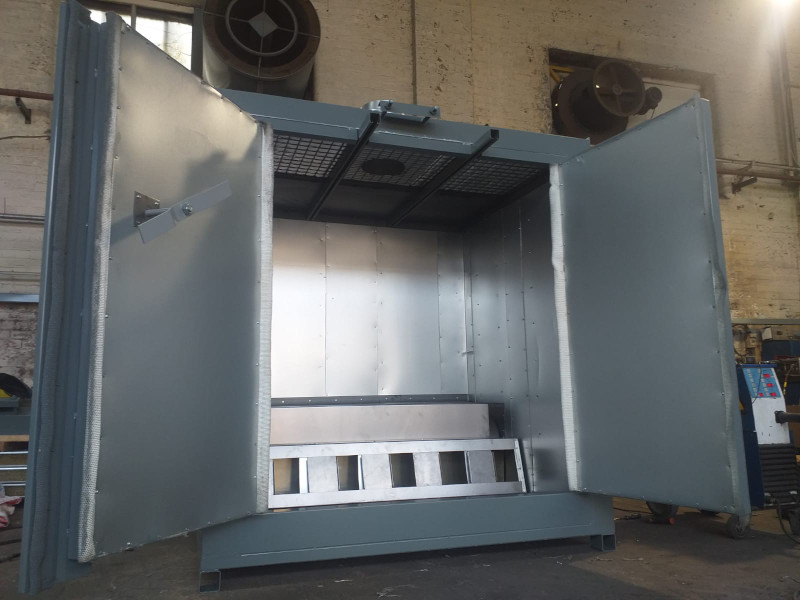
Advanced powder formulations have expanded far beyond basic industrial finishes. Modern coaters regularly process architectural powders, multi-coat systems, textured finishes, specialty chemical-resistant coatings, and products with demanding cure schedules that leave little room for error. Successful results depend on maintaining precise thermal conditions, consistent airflow, and repeatable process control, making oven performance one of the most important factors in achieving a durable, professional finish.
Why Specialty Powder Formulations Demand More Than Basic Heat Sources
Complex powders often require specific cure windows to achieve their intended performance characteristics. A coating may appear finished on the surface while remaining under-cured beneath, creating durability issues that may not become visible until the product enters service.
Accurate temperature management helps eliminate that risk. Reliant powder curing ovens are engineered specifically for powder coating applications, combining insulated construction, controlled airflow, and responsive burner technology that supports consistent curing conditions across a wide range of specialty powder formulations.
How Thick Insulation Helps Maintain Stable Cure Profiles Throughout Production
Thermal stability becomes increasingly important when processing coatings with narrow curing tolerances. Even minor heat fluctuations can influence gloss consistency, chemical resistance, or long-term adhesion on demanding powder systems.
Dense insulation helps create a controlled environment. Reliant powder coating systems utilize 6-inch wall and roof panels filled with high-density mineral wool insulation that reduces heat loss and minimizes the effect of changing shop temperatures on the curing process.
The Role of Forced-Convection Airflow on Complex Part Geometries
Challenging powder applications frequently involve parts with deep recesses, varying thicknesses, and irregular shapes. Reaching every surface with consistent heat exposure can be difficult when airflow design is inadequate.
Engineered circulation systems help solve that challenge. Reliant powder coating equipment incorporates dual-inlet and dual-outlet airflow designs that continuously move heated air throughout the oven chamber, promoting more uniform curing across complicated part profiles.
Eliminating Temperature Stratification During Specialty Coating Cycles
Heat naturally rises inside enclosed spaces, creating the potential for warmer temperatures near the ceiling and cooler conditions closer to the floor. Specialty powders can be particularly sensitive to those variations.
Strategic exhaust placement helps maintain balance. Reliant powder curing ovens use floor-mounted exhaust systems that remove cooler air from lower portions of the enclosure, encouraging more consistent temperatures throughout the entire curing chamber.
Why Burner Response Speed Influences Coating Performance
Complex powders often benefit from stable thermal conditions that remain consistent throughout the entire cure cycle. Slow-reacting heating systems may create temperature swings that affect coating quality and repeatability.
Advanced burner technology improves thermal control. Reliant powder coating equipment utilizes Power Flame forced-induction burners that respond dynamically to system demands, helping maintain target temperatures while reducing unnecessary fuel consumption.
How PID Controls Support Repeatable Results Across Multiple Batches
Production consistency matters when the same coating must be applied across multiple runs, separate shifts, or large project schedules. Differences between batches can create appearance variations that become costly to correct.
Sophisticated control systems help maintain uniformity. Reliant powder coating systems can incorporate PID fuzzy logic controls, PLC integration, and touchscreen interfaces that continuously monitor and adjust oven performance throughout operation.
Multi-Coat Applications Often Require Specialized Thermal Management
Certain finishing processes involve multiple coating layers that must be heated at different stages. These applications may include primers, specialty topcoats, or decorative architectural systems that require controlled transitions between processing steps. Flexible oven configurations support those requirements. Reliant powder coating equipment is available in preheat, drying, curing, and multi-function designs that allow manufacturers to tailor thermal processing to the needs of complex finishing operations.
Why Large Parts Create Additional Curing Challenges
Oversized products often absorb and retain heat differently than smaller components. Heavy fabricated assemblies, architectural sections, and industrial equipment may require significant thermal energy before the coating reaches its intended cure profile.
Generous sizing options help accommodate those applications. Reliant powder curing ovens are available in hundreds of standard sizes and custom configurations that provide adequate clearance, airflow, and thermal capacity for large and high-mass workpieces.
Data Logging Helps Validate Demanding Cure Requirements
Quality-sensitive industries increasingly require proof that coatings were processed according to specification. Documentation can be especially important when specialty powders are used in architectural, transportation, or industrial applications.
Integrated monitoring tools provide valuable verification. Certain Reliant powder coating systems include color touchscreen controls with data logging capabilities that allow operators to record thermal performance throughout each curing cycle. Through advanced airflow engineering, premium insulation, responsive burner systems, flexible configurations, and intelligent process controls, Reliant Finishing Systems provides curing solutions designed to help manufacturers achieve dependable results when processing complex powder coatings that demand precision, consistency, and long-term durability.
