

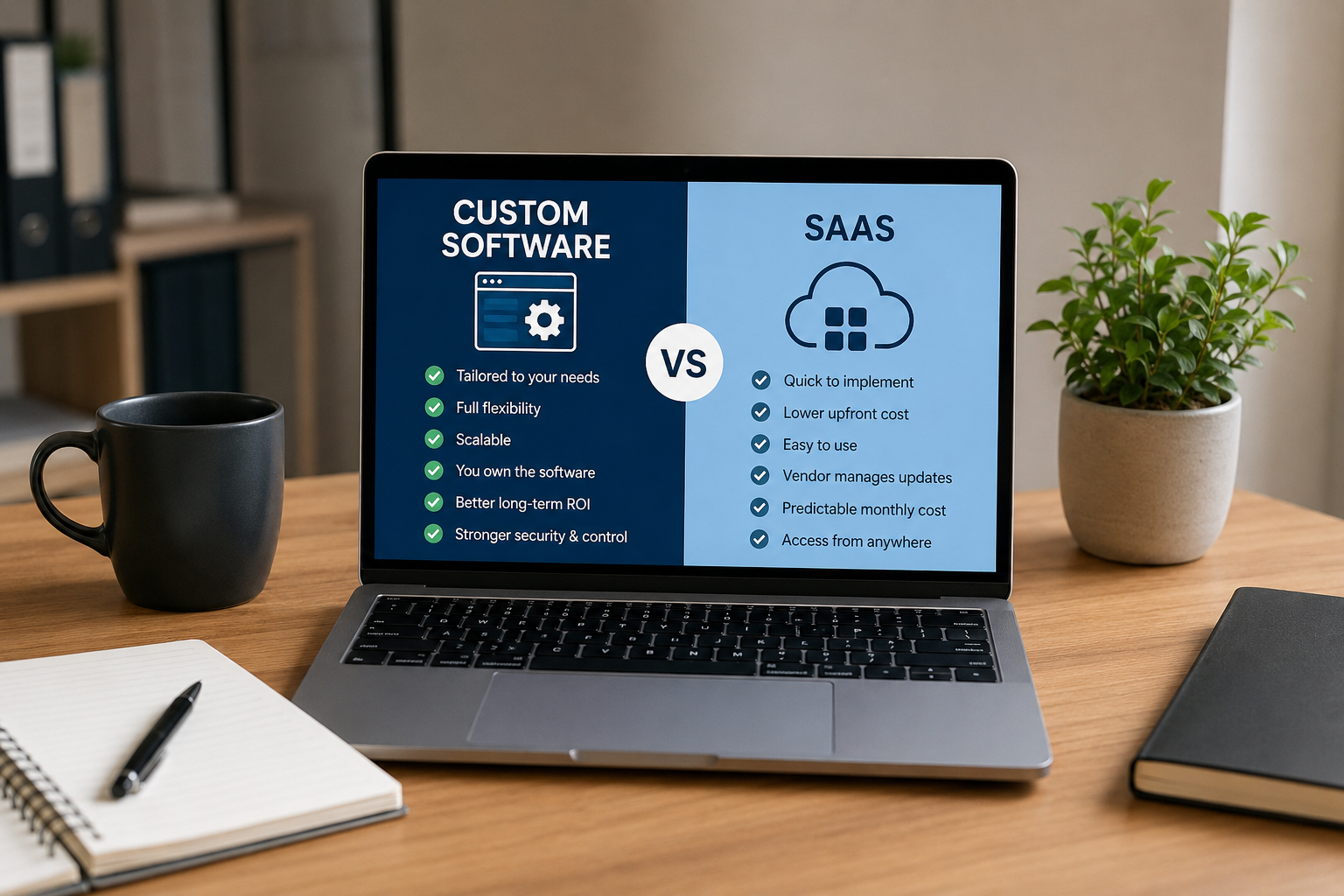
Technology has become the backbone of modern business operations. From customer relationship management and sales tracking to inventory control and internal communication, companies rely on software to remain competitive and efficient. When choosing a software solution, one of the most important decisions business leaders face is whether to adopt a Software-as-a-Service (SaaS) platform or invest in custom software development.
While both options can help organizations streamline operations, improve productivity, and reduce manual work, they differ significantly in terms of flexibility, scalability, ownership, and long-term value. Understanding these differences is essential for making an informed technology investment.
Understanding SaaS Software
Software-as-a-Service (SaaS) refers to cloud-based applications that are delivered through a subscription model. Rather than purchasing and installing software on local servers, businesses access the application through a web browser and pay a recurring monthly or annual fee.
Popular SaaS platforms include CRM systems, project management tools, accounting software, email marketing platforms, and customer support solutions.
The primary reason SaaS has become so popular is convenience. Companies can deploy solutions quickly without needing a dedicated development team or significant upfront investment.
Some common advantages of SaaS include:
- Fast implementation
- Lower initial costs
- Regular updates and maintenance
- Vendor-managed infrastructure
- Reduced IT requirements
- Easy onboarding for teams
For startups and small businesses with relatively simple operational needs, SaaS products often provide an excellent starting point.
However, challenges frequently emerge as organizations grow and their processes become more complex.
Understanding Custom Software
Custom software is developed specifically for a company’s unique requirements. Instead of adapting business processes to fit the limitations of an existing platform, organizations build software that supports their exact workflows, objectives, and operational structure.
Custom applications can include:
- Customer relationship management systems
- Internal business portals
- Workflow automation platforms
- Inventory management systems
- Field service applications
- Client portals
- Mobile applications
- AI-powered business tools
Unlike SaaS solutions, custom software is designed around the business rather than the business being designed around the software.
This level of customization often leads to increased efficiency, reduced operational friction, and stronger competitive advantages.
Flexibility and Customization
One of the most significant differences between SaaS and custom software is flexibility.
SaaS platforms are designed to serve thousands of customers across different industries. Because of this, they provide standardized features that work for a broad audience. While many platforms offer settings and integrations, businesses are still limited by the functionality the vendor chooses to provide.
As companies grow, they often discover that their workflows do not align perfectly with the software they are using. Teams begin creating workarounds, using spreadsheets, or subscribing to additional tools to fill functionality gaps.
Custom software eliminates these limitations.
Organizations can create:
- Tailored workflows
- Custom dashboards
- Industry-specific features
- Unique reporting systems
- Specialized automation
- Custom integrations
This allows businesses to optimize operations instead of compromising processes to fit third-party software.
Scalability for Growing Companies
Scalability is another critical factor when evaluating software solutions.
Most SaaS products scale reasonably well during the early stages of business growth. However, challenges can arise when organizations expand into multiple departments, locations, or markets.
Common scalability issues include:
- Increasing subscription costs
- User limitations
- Restricted customization
- Integration challenges
- Performance bottlenecks
- Data management constraints
Custom software can be designed specifically to support future growth.
Whether a business plans to onboard thousands of customers, manage multiple teams, automate complex workflows, or integrate advanced AI functionality, a custom platform can evolve alongside organizational needs.
This long-term adaptability often makes custom software a strategic investment rather than simply an operational expense.
Ownership and Control
Ownership represents one of the most overlooked differences between SaaS and custom software.
When using SaaS, businesses are essentially renting access to a platform. The vendor controls the product roadmap, pricing structure, feature availability, and platform updates.
If the vendor changes pricing, removes features, or discontinues services, customers have limited control over the outcome.
With custom software, organizations maintain ownership of the platform and have complete control over:
- Development priorities
- Feature implementation
- Data management
- Security requirements
- Third-party integrations
- Future enhancements
This level of control can be particularly valuable for companies operating in highly competitive or specialized industries.
Cost Comparison
Cost is often the primary factor businesses consider when selecting software solutions.
At first glance, SaaS appears significantly less expensive.
Monthly subscriptions typically range from a few dollars per user to several hundred dollars per month depending on the platform and features required.
However, hidden costs frequently emerge over time.
Businesses often end up paying for:
- Multiple software subscriptions
- Additional integrations
- Premium feature upgrades
- Extra user licenses
- Data storage increases
- Third-party automation tools
As a result, software expenses can grow substantially year after year.
Custom software generally requires a higher initial investment. However, organizations often recover that investment through:
- Reduced subscription costs
- Improved operational efficiency
- Increased automation
- Better employee productivity
- Consolidated technology infrastructure
For many growing businesses, the long-term return on investment can significantly outweigh the initial development expense.
Security and Data Management
Security has become increasingly important as businesses manage larger volumes of customer and operational data.
Most reputable SaaS providers maintain strong security standards and invest heavily in infrastructure protection.
However, businesses still rely on third-party vendors to manage sensitive information.
Custom software provides greater control over:
- Data storage
- Access permissions
- Security protocols
- Compliance requirements
- Backup procedures
Companies operating in regulated industries often prefer custom solutions because they can implement security measures that align precisely with their compliance obligations.
Integration Capabilities
Modern businesses rarely rely on a single software platform.
Organizations frequently use dozens of tools for accounting, marketing, customer service, communication, analytics, and operations.
While SaaS platforms offer integrations, compatibility limitations often exist.
Custom software can be developed to connect directly with existing systems, creating a centralized ecosystem that reduces manual work and improves data consistency.
This enables businesses to eliminate redundant processes and establish seamless information flow across departments.
When SaaS Is the Better Choice
SaaS may be the ideal solution if your business:
- Has standardized workflows
- Needs immediate implementation
- Has limited technical requirements
- Operates with a smaller budget
- Requires common business functionality
For many startups, SaaS provides an affordable and efficient way to launch operations quickly.
When Custom Software Is the Better Choice
Custom software often becomes the preferred option when a business:
- Has unique operational requirements
- Uses multiple disconnected systems
- Requires advanced automation
- Needs specialized integrations
- Experiences rapid growth
- Wants complete ownership and control
- Seeks a long-term competitive advantage
In these situations, a tailored platform can deliver substantially greater value than generic software solutions.
Businesses looking to streamline operations, consolidate software tools, and implement scalable technology solutions can work with withnocode to develop custom software, AI-powered applications, automation systems, and business platforms designed around their specific needs.
Conclusion
The decision between SaaS and custom software is not simply a technology choice—it is a strategic business decision.
SaaS solutions offer speed, convenience, and lower upfront costs, making them ideal for organizations with straightforward requirements. Custom software, on the other hand, provides unmatched flexibility, ownership, scalability, and long-term value.
As businesses grow and operations become more complex, many discover that custom software enables them to operate more efficiently, reduce costs, improve customer experiences, and create sustainable competitive advantages.
By carefully evaluating current needs and future objectives, organizations can determine which approach will best support their long-term success.
